
Two Clocks
Every week I follow the news on AI development, and every week I come away with the same unsettling sense that society is behind, not by a little, but in the way you are behind when the race began while you were still tying your shoes.
A new model seems to arrive every week from one lab or another, and if you want a way to feel that pace, picture a car company launching a new model every week while its rivals do the same, so that two new cars reach the road every day and nobody, from the drivers to the mechanics to the people who plan the roads, has time to learn the last one. That is roughly what we are asking of schools, except that cars at least arrive after crash tests and licensing, whereas models arrive first and the rules are written afterward.
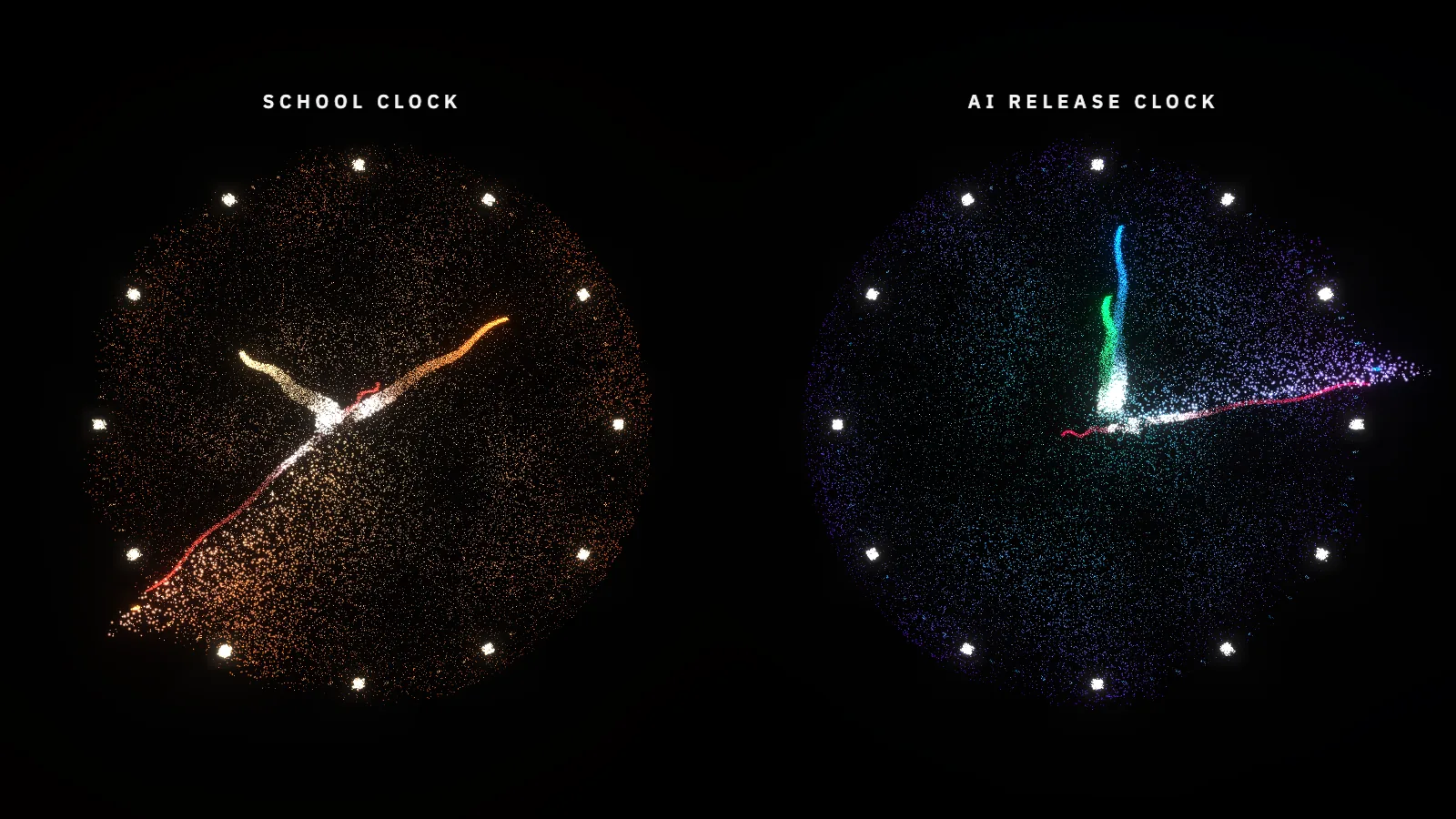
Set that beside the school calendar and the gap becomes hard to ignore. A school year in many systems runs about 180 days, curriculum adoptions often take five to seven years to complete, and teacher preparation takes years before anyone stands in front of a class, all of which exists because schools are built to be stable so that children can rely on them. Frontier AI is built to be replaced, which leaves us living with two clocks that tick in different units, and the distance between them grows every week. Rosa (2013) describes this condition as desynchronization, in which different spheres of social life accelerate at different rates, and scholars of technology governance have long called its regulatory version the pacing problem, in which innovation outruns the legal and ethical oversight meant to guide it (Marchant et al., 2011). This is less a failing of schools or a triumph of technology than a collision between two institutions designed for opposite purposes, one to preserve continuity and the other to outdate itself.
Where the Mismatch Shows Up
Once you start looking, the mismatch is everywhere. A policy written in the spring describes tools that have already changed by the fall, a workshop teaches an interface that is outdated by the time teachers return to their classrooms, and an assignment designed around what AI could not do last year is finished by this year’s model before anyone notices. None of this is new in kind, since the history of educational technology is a long record of schools absorbing new tools slowly and on their own terms (Cuban, 1986; Tyack & Cuban, 1995), but the speed is new, and it turns a familiar pattern into a structural strain. Each of these is a small failure of timing, but together they place a heavy and largely invisible burden on teachers, who are asked to exercise professional judgment about tools that will not hold still long enough to be understood. An ecological view of teacher agency reminds us that judgment is always exercised within the conditions teachers are given, including the time and support to understand what they are being asked to judge (Priestley et al., 2015).
Learning to Steer
The idea I keep returning to is this. A child starting kindergarten today will pass through many generations of these models before graduating, which makes them the first students who will never know a stable AI, and that means teaching the tool cannot be the goal, because the tool will not be the same tool twice. What schools can offer instead is something closer to driver’s education, where the aim is not to master one particular car but to learn how to steer anything, to read the road, and to notice when something is going wrong. Steering is the skill that survives every release.
That commitment also changes what we should protect, because people learn to judge good work by doing the work themselves, and mathematics education research has long argued that wrestling with problems before and alongside instruction is part of how understanding is built (Hiebert & Grouws, 2007). A student who never struggles through a problem alone never builds the judgment needed to catch a machine’s mistakes, and the learning sciences suggest that such effort supports durable learning precisely because it feels harder in the moment (Bjork & Bjork, 2011). A measure of unassisted practice is therefore not nostalgia but the way we keep a generation of drivers who can tell when the car is wrong.
Preparing Without Chasing
I do not think schools should chase every release, since deliberation is a real strength when children are involved, but I do think we can prepare in a few practical ways:
- Teach verification, meaning how to check a claim, trace a source, and test an answer against what you already know, a skill that works on every model.
- Write policy around lasting values such as transparency, human oversight, and fair access, and review the technical details every term instead of every decade.
- Give teachers time to explore and not only to be trained, so that they are partners in change rather than recipients of it.
I hold all of this with some humility, because I cannot see inside the labs and a fast release schedule is not the same thing as fast progress in capability. Yet the feeling of being behind is real and deserves to be taken seriously, most of all for under-resourced schools and Global South communities, who have the least room to absorb constant change and the least say in how quickly it arrives.
Whose Clock Sets the Pace
The question, then, is not whether schools can match the launch schedule, since they cannot and should not try, but whether the people responsible for education will have a meaningful voice in how fast this goes, and whether we will raise learners who can steer, whichever model arrives next. Those decisions will not be made by the clocks themselves. They will be made by teachers, families, researchers, and communities who insist on being part of the conversation, and I would welcome hearing from anyone who is living with this mismatch in their own classroom, campus, or ministry.
References
Bjork, E. L., & Bjork, R. A. (2011). Making things hard on yourself, but in a good way: Creating desirable difficulties to enhance learning. In M. A. Gernsbacher, R. W. Pew, L. M. Hough, & J. R. Pomerantz (Eds.), Psychology and the real world: Essays illustrating fundamental contributions to society (pp. 56–64). Worth Publishers.
Cuban, L. (1986). Teachers and machines: The classroom use of technology since 1920. Teachers College Press.
Hiebert, J., & Grouws, D. A. (2007). The effects of classroom mathematics teaching on students’ learning. In F. K. Lester Jr. (Ed.), Second handbook of research on mathematics teaching and learning (pp. 371–404). Information Age Publishing.
Marchant, G. E., Allenby, B. R., & Herkert, J. R. (Eds.). (2011). The growing gap between emerging technologies and legal-ethical oversight: The pacing problem. Springer.
Priestley, M., Biesta, G., & Robinson, S. (2015). Teacher agency: An ecological approach. Bloomsbury Academic.
Rosa, H. (2013). Social acceleration: A new theory of modernity. Columbia University Press.
Tyack, D., & Cuban, L. (1995). Tinkering toward utopia: A century of public school reform. Harvard University Press.
Cite this article
Gattupalli, S. (2026). School Years vs. Release Cycles: Teaching in a World That Updates Weekly. Society and AI. https://societyandai.org/perspectives/release-cycles-vs-school-years/
Have a perspective on how schools should respond to the pace of AI release cycles? We want to hear it. Society & AI publishes in open access, free for anyone thinking seriously about these questions. Send your proposal to [email protected].
Interactive clocks adapted from Techartist / CodePen.