PERSPECTIVES
Artificial Intelligence in Education: A Necessary Evil or a Question of Purpose?
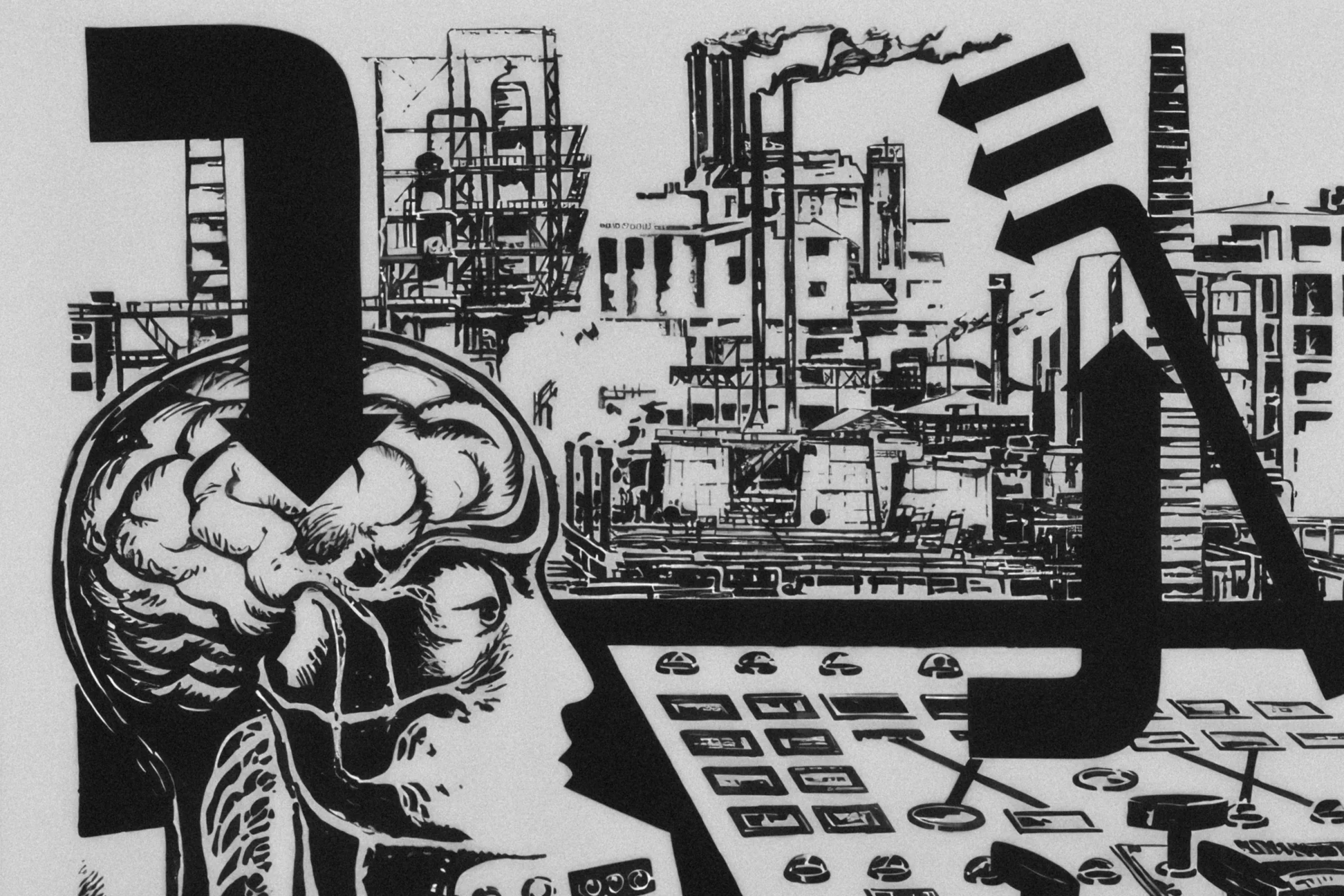
Image Credits: Avo Keerend, Ringlus (1973), Tartu Art Museum/Europeana
Artificial Intelligence (AI) is no longer an abstract idea in education; it is already embedded in how students learn, how teachers teach, and how institutions function. From tools that generate essays to systems that personalise learning, AI is reshaping classrooms at a remarkable pace.
The central argument of this piece is simple: AI in education is a necessary evil. I describe AI as a “necessary evil” only in a limited sense. It may be useful where teachers are stretched, learning support is scarce, or students need another route into difficult material (Tunjera & Chigona, 2023), and it addresses real challenges such as scale, access, and efficiency (He et al., 2020). But it is also an “evil” in the sense that it risks weakening deep learning (Elzerman, 2025), altering the role of teachers (Liu & Wang, 2020), and raising concerns about fairness and control (Weber, 2020). The more important question is whether a particular use of AI helps learners understand more, participate more fully, or receive support they would otherwise lack. Its value depends on the design of the activity and the availability of human guidance, as well as on who controls the tools and data (UNESCO, 2023).
Why AI feels necessary
Education systems across the world are under pressure. Class sizes are growing, expectations are rising, and resources are often limited. AI offers practical solutions. For teachers, AI can automate repetitive tasks such as grading and attendance tracking. For students, it can provide instant explanations and personalised feedback. For institutions, it can help manage large volumes of data and improve decision-making. These benefits are not trivial. In many cases, AI can improve access to quality education, especially for students who may not have access to experienced teachers or additional support. Reports such as the Center for Curriculum Redesign’s overview of AI in education (Holmes et al., 2019) highlight how AI can support more inclusive and flexible learning environments. In this sense, AI is not just useful. It is becoming indispensable.
The hidden cost: when learning becomes too easy
However, education is not only about efficiency. It is also about effort, struggle, and the gradual development of understanding. AI changes this balance. When students can generate answers instantly, they may skip the process of thinking deeply about a problem. This is sometimes called “cognitive offloading” (Gerlich, 2025), which means relying on technology to do the thinking for us. As Carr (2008) discussed in relation to how digital tools affect our thinking, constant reliance on technology can reduce our ability to concentrate and reflect. In education, this can mean that students focus on completing tasks rather than understanding them. The result is a shift from learning how to think to learning how to produce answers.
Teachers: adapting to a changing role
For teachers, AI is both a support system and a challenge. On the positive side, AI can help identify student learning gaps, suggest teaching strategies, and reduce administrative workload. This allows teachers to spend more time on meaningful interactions with students. At the same time, AI changes the traditional role of the teacher. Students no longer depend solely on teachers for information as they can access explanations from AI tools at any time. This reduces the teacher’s role as a “knowledge provider” and shifts it towards being a guide or facilitator. This transition is not necessarily negative, but it requires adjustment. Teaching becomes less about delivering content and more about helping students interpret, question, and apply knowledge. There is also a risk that over-reliance on AI could reduce the depth of teaching itself (Elzerman, 2025). As Illich (1971/1973) argued in his critique of institutional education in Deschooling Society, systems that rely too heavily on technology can weaken human autonomy and judgment.
Students: empowered or dependent?
In a Human Resource Management class case assignment, I may ask students to analyse why employees are leaving an organisation, using evidence from the case. After forming their own explanation, students could use AI to generate alternative causes, then evaluate these suggestions against the case facts and explain which they accept or reject. This structured approach supports analysis, while simply asking a chatbot to “write my case answer” may undermine it. The effectiveness depends in part on assignment design.
Students benefit significantly from AI tools. They can access explanations instantly, explore topics at their own pace, and receive feedback without delay. For many, this creates a more supportive learning environment. But this convenience comes with a trade-off. When AI becomes the default way to solve problems, students may begin to depend on it. This can reduce their confidence in their own abilities and limit their willingness to engage with difficult tasks. Another important issue is academic integrity. When AI tools can generate essays or solve assignments, it becomes harder to define what counts as original work. Students must now learn not just what to study, but how to use AI responsibly. This is a new kind of skill, one that education systems are only beginning to address.
The bigger picture: data, bias, and control
Some educational platforms and predictive systems track student activity or performance to spot patterns and identify learners who might need help. These tools can help institutions respond sooner, but they also raise questions about what gets measured, who can see the data, and whether students can challenge how a model interprets their actions (Dai et al., 2025). Foucault’s (1975/1977) idea of surveillance is one way to think about how monitoring can influence behaviour. In this case, it serves as a conceptual analogy, while evidence about AI surveillance in education comes from studies that look directly at educational systems.
Living with AI’s trade-offs
Calling AI a “necessary evil” captures a tension, but each use should be judged on its own merits. When it supports learning while leaving students responsible for their reasoning and teachers responsible for their judgment, it can serve education. When it encourages passive completion or makes decisions that students cannot question, its costs may outweigh its benefits. The aim is to make AI serve education’s purposes.
What needs to change
If AI is to play a constructive role in education, several shifts are needed. First, teachers must remain central. AI should support teaching, not replace it. The human aspects of education like mentorship, empathy, and ethical judgment cannot be automated (Kotsini, 2026). Second, students need to develop critical awareness of AI. They should understand its strengths, limitations, and ethical implications. This is as important as any academic subject. Third, institutions must ensure transparency and accountability. Decisions that affect students’ futures should not be made by algorithms alone. Finally, education itself must evolve. In a world where information is easily available, the goal of education should be to develop critical thinking, creativity, and the ability to navigate complexity.
Rethinking the purpose of education
AI forces us to ask a fundamental question: what is education for? If education is about efficiency and output, AI fits perfectly. But if it is about developing independent thinkers and responsible citizens, then AI must be used carefully. The future of education will not be defined by whether we adopt AI, but by how we integrate it. In this sense, the old wisdom still holds true: artificial intelligence is a good servant, but a poor master. Used thoughtfully, it can support learning, expand access, and enhance teaching. Allowed to dominate, it risks reshaping education in ways that undermine human agency and intellectual growth. Treating AI as a necessary evil is therefore not a rejection of technology, but a call for balance—a reminder that education must remain, at its core, a deeply human endeavour.
References
- Carr, N. (2008). Is Google making us stupid? Teachers College Record, 110(14), 89–94. https://doi.org/10.1177/016146810811001427
- Dai, R., Thomas, M. K. E., & Rawolle, S. (2025). Revisiting Foucault’s panopticon: How does AI surveillance transform educational norms? British Journal of Sociology of Education, 46(5), 650–668. https://doi.org/10.1080/01425692.2025.2501118
- Elzerman, G. H. (2025, May). When AI does the thinking: The risks of over-reliance on artificial intelligence in higher education language learning. In 2025 5th International Conference on Artificial Intelligence and Education (ICAIE) (pp. 773–778). IEEE. https://doi.org/10.1109/ICAIE64856.2025.11158185
- Foucault, M. (1977). Discipline and punish: The birth of the prison (A. Sheridan, Trans.). Pantheon Books. (Original work published 1975)
- Gerlich, M. (2025). AI tools in society: Impacts on cognitive offloading and the future of critical thinking. Societies, 15(1), Article 6. https://doi.org/10.3390/soc15010006
- He, M., Li, Z., Liu, C., Shi, D., & Tan, Z. (2020). Deployment of artificial intelligence in real-world practice: Opportunity and challenge. The Asia-Pacific Journal of Ophthalmology, 9(4), 299–307. https://doi.org/10.1097/APO.0000000000000301
- Holmes, W., Bialik, M., & Fadel, C. (2019). Artificial intelligence in education: Promises and implications for teaching and learning. Center for Curriculum Redesign.
- Illich, I. (1973). Deschooling society. Penguin. (Original work published 1971)
- Kotsini, S. (2026). Rethinking education: Artificial intelligence, empathy, and emerging ethical challenges. Mediterranean Journal of Education, 6(1), 32–45. https://academia.library.upatras.gr/mje/article/view/5533
- Liu, J., & Wang, S. (2020, June). The change of teachers’ role in teaching under the environment of “Artificial Intelligence +”. In 2020 International Conference on Artificial Intelligence and Education (ICAIE) (pp. 98–102). IEEE. https://doi.org/10.1109/ICAIE50891.2020.00030
- Tunjera, N., & Chigona, A. (2023, October). Investigating effective ways to use artificial intelligence in teacher education. In 22nd European Conference on e-Learning: ECEL 2023 (pp. 331–340). Academic Conferences and Publishing International. https://doi.org/10.34190/ecel.22.1.1625
- UNESCO. (2023). Guidance for generative AI in education and research. UNESCO. https://doi.org/10.54675/EWZM9535
- Weber, A. (2020). Ethics concerns in artificial intelligence use in education. In INTED2020 Proceedings (pp. 4539–4544). IATED. https://doi.org/10.21125/inted.2020.1262
About the Author
Saswat Barpanda, PhD, is an Associate Professor of Organizational Behaviour and Human Resource Management at the Goa Institute of Management. His research explores intellectual capital, strategic HRM, and the intersections of education, ethics, and society.
Cite this article
Barpanda, S. (2026). Artificial intelligence in education: A necessary evil or a question of purpose? Society and AI. https://societyandai.org/perspectives/ai-in-education-necessary-evil-or-question-of-purpose/
Write for Society & AI
Are you working through what AI means for learning, knowledge, or human flourishing? We would welcome your perspective. Everything Society & AI publishes is free and open access, written for readers who take these questions seriously. Share your idea with us at [email protected].