
Image: Marek Kupiec / Pexels
From Principle to Practice: Testing and Releasing the ACORN Toolkit for Whole-Program AI Literacy
Professors created, piloted, and now are sharing a practical toolkit to support other professors in moving from fragmented, individual treatments of AI to shared, discipline-specific, student-centered decisions about if, when, and how AI literacy belongs in their programs.
Key Takeaways
- Pilot testers needed a tool chest to choose from, not an online course to complete
- Whole-program AI work can expose curricular misalignments that predate AI
- The ACORN Toolkit is now public and can be installed in an institution’s own Canvas
In early Spring 2026, Society & AI published “The Case for Coherent, Whole-Program AI Literacy Integration.” In that essay, we argued that higher education could not meet the challenges of artificial intelligence through isolated course policies, scattered faculty workshops, or individual instructors working alone. Students experience a major or program as a whole. They need to know not only what is permitted in a particular class, but why AI use is sequenced as it is in their program of study. They also need to know how AI relates to the knowledge, practices, values, and professional expectations of their field.
To address that problem, with support from the California State University (CSU) system via the AI Educational Innovations Challenge program, we brought together diverse faculty members to form the AI-Ready Curricular Options Resource Network (ACORN). We also included two student members, to ensure we took into account issues that only students might see. Once assembled, the taskforce set to work developing an approach to helping other faculty address the coherence question.
The result — the ACORN Toolkit — is a collection of worksheets, protocols, conversation starters, templates, and other job aids designed to help faculty weave AI literacy into their programs strategically, with the kind of intentionality necessary to ensure that the education we offer meets today’s students’ needs.
The ACORN Toolkit is now available across the CSU ("the nation’s largest, most diverse and most consequential four-year university system") and to the public. Having made the case for ACORN previously, here, we offer a summary of the work undertaken since then to pilot test the Toolkit. We then discuss how best to choose and deploy the tools available.
A highly detailed and extensive version of what we present below will be found in Shultz, Sobo, Henry, Pollard, and Salas (“The ‘How’ of an Integrated Curriculum Approach to AI: The ACORN Toolkit”; in review). By contrast, our summary here provides, with concision, actionable information in support of the Toolkit’s practical application.
Pilot Testing
During spring and summer 2026, we tested the Toolkit at our home institution, San Diego State University. Pilot testers included faculty representing programs across a wide range of fields, including anthropology, sociology, history, journalism, public health, geography, linguistics, rhetoric and writing studies, hospitality and tourism, and library services. This breadth mattered, given that the ACORN Toolkit was intended for use across programs with different cultures, curricular structures, and levels of readiness regarding AI. Also, to ensure the highest possible utility of responses, we recruited faculty who were positioned to lead program-level work, including curriculum committee chairs and faculty from across the university’s colleges.
While most of the above volunteers were left to use the Toolkit as they saw fit or as they were able, then invited to report back to us, we also did some direct observations. Fourteen volunteer faculty members participated in cognitive walkthroughs. For our purposes, this meant opening the Toolkit and attempting to navigate it as prospective “change facilitators” while narrating their thoughts aloud to Taskforce members.
Taken together, the feedback from pilot testers revealed navigational, conceptual, and explanatory problems that would not have been apparent from the design team’s perspective. Some of the most consequential revisions occurred in response to the following findings; i.e., that users:
- Mistook the Toolkit’s Canvas site for a conventional online course
- Expected AI applications to be included
- Needed reminders to keep thinking at the program level
- Discovered (in a few cases) pre-existing curricular misalignments
Because ACORN is housed in Canvas, a learning management system (LMS) widely used by institutions of higher education, early users assumed they were expected to take a conventional online course and proceed linearly. They thought they had to ask other department members to enroll. Some expected AI applications or specific instructions on how to use particular tools rather than worksheets, protocols, templates, and other job aids for facilitating curricular conversations.
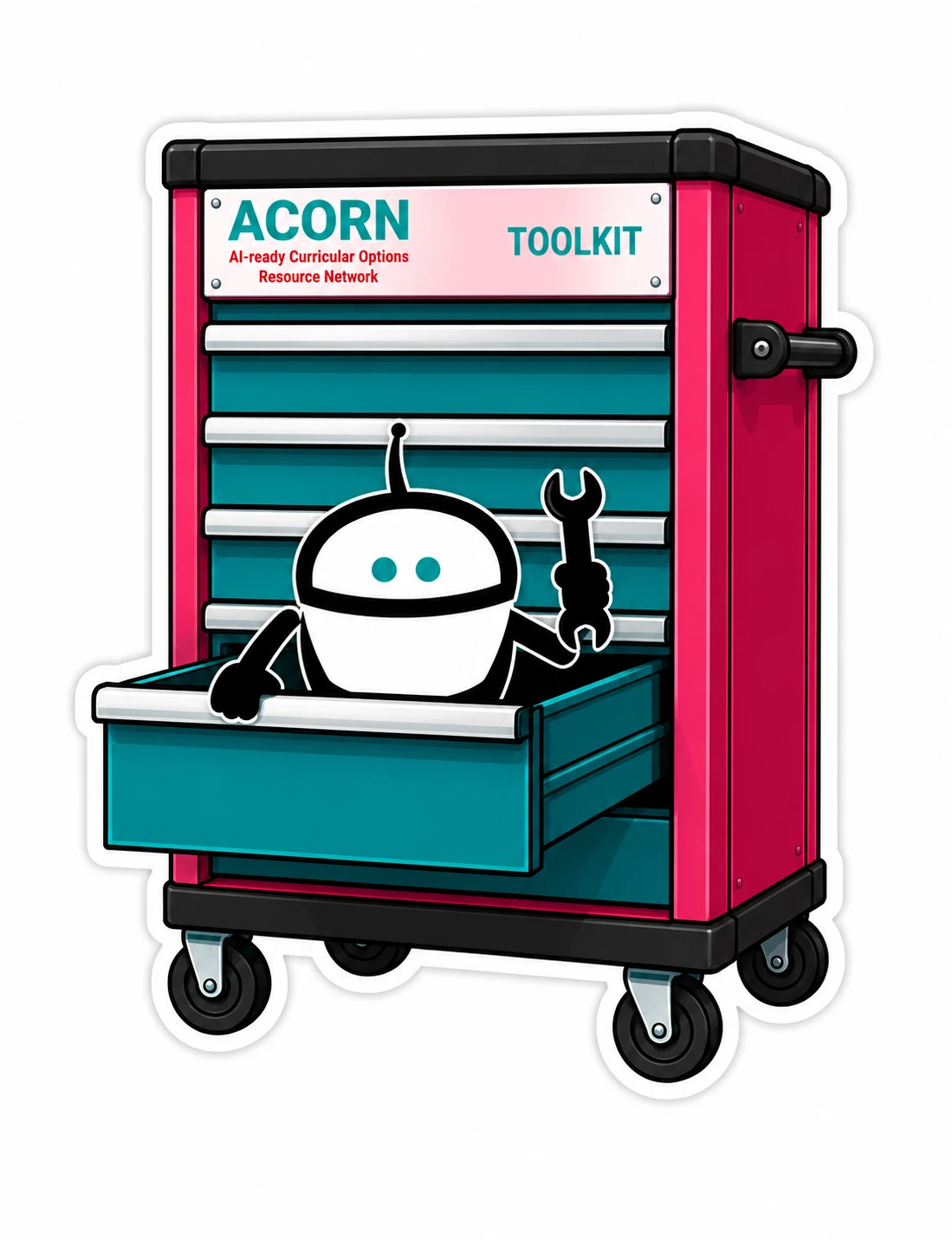
In response, we replaced the online course metaphor with a tool-chest model, added a visual map of the available resources as well as tool-chest iconography (see Figure 1), clarified estimated time commitments and listed each given tool’s intended users and expected products or outcomes, and emphasized that programs should select only the tools suited to their circumstances. To this end, we created a set of suggested menus so that, for instance, a department already well invested in a coherent stance on AI literacy might choose only certain more advanced (‘core’) tools while one that has barely begun to talk about AI openly would choose more ‘preparatory’ options.
Here it’s worth noting that one persistent challenge was keeping users focused on the curriculum as a system versus reverting to a focus on individual assignments or courses. The AI-related triage mode that most had taken up during the early days of the technology was difficult to shed. In response, we peppered reminders to stick to program-level thinking throughout the Toolkit liberally.
The testing also exposed a substantive issue of importance well beyond AI. AI-related curricular work depends on knowing what a program is already trying to teach, where that learning occurs, and how students are expected to progress. If those structures are unclear, the ACORN process makes the problem visible. And so, some pilot testers discovered that their curricula were not as well aligned as they had assumed. In several cases, lower- and upper-division courses did not clearly scaffold one another, sections of the same course had diverged, or prerequisite structures no longer reflected an intentional progression of skills. This meant that AI integration could not always be treated as a discrete addition to an otherwise stable curriculum. For some departments, the ACORN process became an opportunity to identify broader curricular gaps while also determining where AI literacy belonged.
The pilot improved the Toolkit’s usability and clarified the support departments will need before undertaking whole-program curricular work. It also showed that an effective process must account for institutional, disciplinary, and interpersonal conditions; make its purpose unmistakable; and offer tools flexible enough to meet departments where they are.
The pilot did not test whether ACORN improves student learning or produces lasting curricular change. That evaluation will occur in the next stage of the project. We will also continue collecting user feedback.
Practical Action
AI tools now abound. What is lacking are the organizational and social conditions in which faculty can decide together if, when, and how AI literacy belongs in their programs.
The pilot confirmed that starting conversations to this end is not always easy. Departments need opportunities to understand their own cultures, acknowledge differences in faculty perspectives, examine evidence, and build enough trust to deliberate together. Faculty may agree that their curriculum needs attention while holding sharply different views about AI. Some may be eager to experiment; others may be skeptical or opposed. Some may be concerned primarily about ethics, authorship, or learning. Others may be focused on workforce preparation, student expectations, or the time required to change already crowded curricula. Engaging with these differences is part of the work.
ACORN offers a collection of resources that change facilitators can use to support such efforts as well as the focused AI literacy planning work that will follow. They just have to open the Toolkit’s drawers, select the tools that fit their circumstances, and apply them as needed. Given our pilot findings, we now include a handout with a number of pre-selected tool sets that change facilitators might choose depending on how they see their department’s situation. A map of the tools or contents reference list is also on offer for those who want to orient themselves holistically to begin with. For more on the tools themselves, their organization, and the justification for the absence of a single pathway, please see The Case for Coherent, Whole-Program AI Literacy Integration.
ACORN’s objective is not to insert AI into every course or produce uniformity across disciplines. AI literacy will look different for different programs. The relevant question is not “How can we make this program use AI?” but “What should graduates of this program understand and be able to do in a world in which AI is increasingly present?” Those decisions belong to faculty working within their disciplines and in conversation with their students. And in offering an infrastructure for beginning and organizing a context-sensitive conversation, ACORN supports faculty judgment rather than replacing it.
Here it is important to note that ACORN’s tools cannot eliminate disagreement. And in fact, the goal is not creating consensus but a workable process for making informed, program-level decisions: Applying the tools can bring a program’s faculty together such that disagreements become generative rather than combative.
ACORN also does not create time where none exists. Institutions must also recognize that this work requires labor. “Keeping up” may be part of a professor’s job, but substantial curricular redesign cannot simply be added to an already excessive workload without reducing other demands or providing compensation.
Readers can find the Toolkit at aaai.sdsu.edu/initiatives/acorn. From that page, faculty, department chairs, curriculum leaders, and other change facilitators can access the public Canvas site, select the tools most appropriate to their programs, and download individual resources for electronic or hard-copy use. The complete Toolkit can also be exported for installation in an institution’s own Canvas instance.
In the absence of deliberate program-level action, curricula will continue to change unevenly through individual improvisation. ACORN offers departments a way to reclaim collective agency: bring the faculty who constitute a program together to examine the evidence and decide collectively what AI literacy should entail.
AI-Ready Curricular Options Resource Network (ACORN) Taskforce members included: Alvin Henry (Associate Professor and Chair, Asian American Studies; also then CAL Careers Hub lead); Beth Pollard (Professor and Chair, History); Consuelo Salas (Assistant Professor, Rhetoric and Writing); Fernando Bosco (Professor and Chair, Geography); Rob Malouf (Professor and Chair, Linguistics); Sam Kobari (Lecturer, Anthropology); and Sobo and Shultz along with two student representatives, Abir Mohamed and Rosabel Ibrahim.
Cite this article
Sobo, E. J., & Shultz, N. (2026). From principle to practice: Testing and releasing the ACORN Toolkit for whole-program AI literacy. Society and AI. https://societyandai.org/insights/from-principle-to-practice-acorn-toolkit/


Write for Society & AI
Is there a question about AI, education, or society that you keep returning to? We would welcome your contribution. Society & AI publishes the work of educators, researchers, policymakers, and practitioners in full open access, free for every reader. Send your proposal to [email protected].